
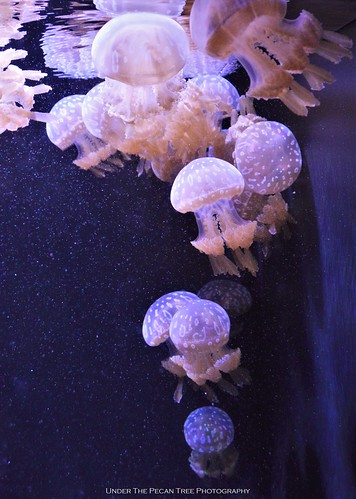
Jellyfish, a class of marine invertebrate animals, have been around for a very long time, even longer than dinosaurs. Scientists always believed jellyfish originated some 500 million years ago, a theory confirmed by the 2007 discovery of perfectly preserved 505-million-year-old jellyfish fossils in Utah, U.S. This find was particularly mind-boggling because jellyfish, having no bones to speak of, rarely leave a trace of their existence like other animals do.
Jellyfish have always boggled minds, particularly with their distinctive structures. Their mostly transparent bodies, wiry tentacles, and lack of bodily organs confounded early scientists so much that they couldn’t even classify these guys — back when categories were only plants, animals, and humans. Jellyfish weren’t plants, but they didn’t fit the specified mold of animals either. The world simply dubbed (classified) them as ‘incomplete’ and didn’t bother investigating further, at least until the microscope was invented. Many such ‘incomplete’ organisms didn’t neatly fit into any category naturalists created, and they were forced to reexamine their categories and come up with new definitions for each.
However, it wasn’t until Charles Darwin proposed his theory of evolution in 1859 — “all living things show a variation in physical traits over time as a process of natural selection” — that the jellyfish got some recognition. Then, the German zoologist and naturalist Ernst Haeckel wrote a book, “Generelle Morphologie der Organismen,” in 1866, which translates to “General Morphology of Organisms.” In it, he illustrated the evolution of many organisms — jellyfish included — to show how primitive animal forms gradually came to be the versions we all know now. He theorized that jellyfish had split from the rest of the organisms at an earlier date — this is why they look so different from other species.
The world began researching the species and has never looked back. In the process, we are also reevaluating the use of ‘fish’ in the ‘jellyfish’ name. ‘Fish’ commonly refers to animals with a backbone, and scientists now sometimes call them ‘jellies’ too. This invasive species has survived and thrived almost all over the world because it needs very little oxygen. They can survive in any water, enjoy a broad diet, reproduce very quickly, and shrink when food reserves are reduced, only to revive themselves when food is available again.









 Under The Harvest Moon