


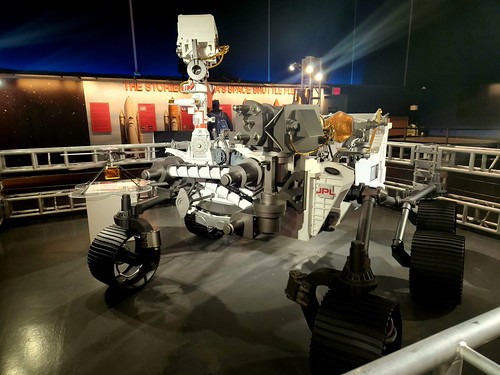
Around 400 BC, the Babylonians began keeping records of celestial events. They called Mars “Nergal,” The King of Conflicts, ostensibly because of the association between the planet’s color and the bloodshed in armed encounters with enemies. The ancient Greeks and Romans must have made the association as well, because in both their pantheons, Ares and Mars, respectively, were known as the gods of war.
As time went on and it became a possibility that man might one day travel among the stars, authors and filmmakers availed themselves of the sense of wonder surrounding the Red Planet and created works of science fiction and just plain fancy, imagining walking on that rusty ground.
One big question was whether Mars held good old-fashioned water, the source of any life on a planet. Flyby missions detected polar ice caps. Ancient “canals” were shown to be optical illusions, but that didn’t stop many believers from presuming that there had previously been civilizations on the fourth planet from the sun.
It still stands to reason that imaginations have blossomed around the notion of life on Mars, from the classic novel “Stranger In a Strange Land” by 1950s author Robert Heinlein, to 2015’s Ridley Scott film starring Matt Damon, “The Martian.”
During this century, orbiter and rover missions sent back increasingly detailed information about Mars, until NASA and its international counterparts began to plan manned missions to Mars. Now, National Red Planet Day commemorates the launch of the Mariner 4 spacecraft on November 28, 1964. Mariner 4 performed the first successful flyby of Mars, returning the first pictures of the Martian surface.
 Under The Harvest Moon