



A Texas city girl in a small New England town …

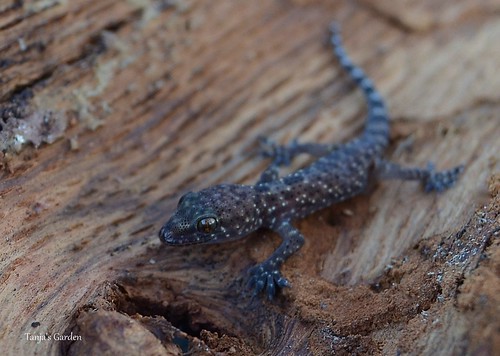
The Mediterranean House Gecko is a relatively small, 4 – 5 in (10 – 13 cm), species that has become ubiquitous in certain areas of the United States. Unlike any native lizard, geckos have sticky toe pads and vertical pupils, and their large eyes lack eyelids. These geckos are generally light gray or almost white in color but may have some darker mottling. This species is most easily distinguished from the similar Indo-Pacific gecko by its bumpy (warty) skin. The Mediterranean House Gecko can usually be found praying on insects near external house lights or other forms of lighting on warm nights.
Like most other invasive species, the Mediterranean House Gecko breeds rapidly. Females are capable of laying multiple clutches of two eggs each throughout the summer. These eggs are laid in cracks and crevices in trees or man-made structures, including buildings. Like rodents, the Mediterranean House Gecko has been aided by human development. It is very common to see the geckos on the sides of buildings under lights catching insects on a summer night.
It is uncertain how the Mediterranean House Gecko first made its way to the United States. It was first reported in Key West, Florida 1915. It is thought that this gecko was probably a stowaway on a ship from the Mediterranean area. Mediterranean House Geckos are quite common in the pet trade, which has no doubt led to their spread across the United States. Currently, this species has high numbers in Florida and has established breeding populations all along the Southern states.
: http://www.tsusinvasives.org/home/database/hemidactylus-turcicus





The red-eared slider (Trachemys scripta elegans) is a subspecies of the pond slider (Trachemys scripta), a semiaquatic turtle belonging to the family Emydidae. It is the most popular pet turtle in the United States, is also popular as a pet worldwide, and is the most invasive turtle. It is the most commonly traded turtle in the world. The red-eared slider is native from the Midwestern United States to northern Mexico, but has become established in other places because of pet releases, and has become invasive in many areas where it outcompetes native species. The red-eared slider is included in the list of the world’s 100 most invasive species.
The carapace of this species can reach more than 40 cm (16 in) in length, but the typical length ranges from 15 to 20 cm (6 to 8 in). The females of the species are usually larger than the males. They typically live between 20-30 years, although some individuals can live for more than 70 years. Their life expectancy is shorter when they are kept in captivity. The quality of their living environment has a strong influence on their lifespans and well-being.
The shell is divided into the upper or dorsal carapace and the lower, ventral carapace or plastron. The upper carapace consists of the vertebral scutes, which form the central, elevated portion; pleural scutes, which are located around the vertebral scutes; and then the marginal scutes around the edge of the carapace. The rear marginal scutes are notched. The scutes are bony keratinous elements. The carapace is oval and flattened (especially in the male) and has a weak keel that is more pronounced in the young. The color of the carapace changes depending on the age of the turtle. It usually has a dark green background with light and dark, highly variable markings. In young or recently hatched turtles, it is leaf green and gets slightly darker as a turtle gets older, until it is a very dark green, and then turns a shade between brown and olive green. The plastron is always a light yellow with dark, paired, irregular markings in the center of most scutes. The plastron is highly variable in pattern. The head, legs, and tail are green with fine, irregular, yellow lines. The whole shell is covered in these stripes and markings that aid in camouflaging an individual.
These turtles also have a complete skeletal system, with partially webbed feet that help them to swim and that can be withdrawn inside the carapace along with the head and tail. The red stripe on each side of the head distinguishes the red-eared slider from all other North American species and gives this species its name, as the stripe is located behind the eyes, where its (external) ears would be. These stripes may fade over time. The color and vibrance of ear stripes can indicate immune health, with bright red indicating a stronger immune response than yellow stripes. Some individuals can also have a small mark of the same color on the top of their heads. The red-eared slider does not have a visible outer ear or an external auditory canal; instead, it relies on a middle ear entirely covered by a cartilaginous tympanic disc.
Like other turtles, the species is poikilotherm and thus dependent on the temperature of its environment. For this reason, it needs to sunbathe frequently to warm up and maintain body temperature.








 Under The Harvest Moon