2026 · National Day Calendar

Earth’s Rotation Day 2026 💫

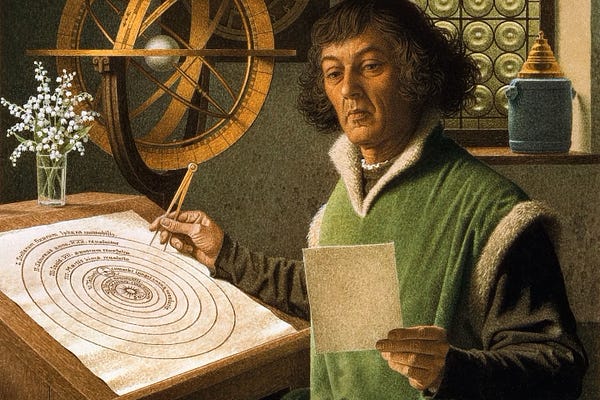
Nicolai Copernicus

The rotation of the Earth and its relationship to our daylight cycles have fascinated philosophers and scientists for thousands of years. As far back as 470 BCE, ancient Greeks speculated that the Earth itself moves, rather than having the rest of the sky revolving around us. In the 10th century CE, Muslim astronomers began building astrolabes and other instruments to measure the Earth’s motion relative to the stars. 

The first human depictions of the cosmos date back to 1,600 BCE. A bronze disk found in Northern Europe depicts the sun, a crescent moon, and the Pleiades star cluster, and Babylonian written records record the positions of celestial bodies. Arguably, the earliest scientific observations, these records make astronomy the oldest known science.

Although humans have observed the stars for thousands of years, some early theories proposed that the Earth moved — the geocentric theory remained dominant in Europe until the work of Nicolaus Copernicus in the 1500s, proving the Earth does actually revolve around the sun. Following his work, others tried to prove the rotation of the Earth through various experiments. While the theory became accepted by the mid-1800s through observation of astronomical movements, it was Foucault’s pendulum that demonstrated, visibly and spectacularly, the rotation of the Earth.

Foucault first conducted his pendulum experiment in the Paris Observatory, then the Panthéon, where it remains an impressive centerpiece today. While they vary in size, pendulums work best with long lines, typically between 40 and 100 feet. A heavy, swinging lead bob is suspended at the end of a line. As the bob swings back and forth, it slowly moves in a clockwise direction as the Earth rotates under it.


:https://nationaltoday.com/earths-rotation-day/

2026 · National Day Calendar

Old Rock Day 2026

The study of rocks was first introduced by the Ancient Greek Theophrastus in his work, “Peri Lithon” (“On Stones”), and became the cornerstone of geology for other interested scientists. The study was advanced by Pliny the Elder, who recorded numerous minerals and metals in great detail, with a particular focus on their practical use. Although working without the tools we use today, Pliny correctly identified amber’s origin as fossilized tree resin. 

It wasn’t until 1603 that the word ‘geology’ was used for the first time by Italian naturalist Ulisse Aldrovandi. It took a further 150 years for the first geological maps to be drawn by British geologist William Smith, whose work began by ordering rock layers by examining the fossils contained in them. 

Then, in 1785, James Hutton wrote and presented a paper to the Royal Society of Edinburgh called ‘Theory of the Earth’, which outlined his belief that the world was far older than previously thought. His breakthroughs make him widely considered the first modern geologist.

In 1809, William Maclure produced the first geological map of the USA, a task he completed thanks to two painstaking years spent personally traversing the country. With the invention of radiometric dating in the early 20th century, scientists could finally provide an accurate figure for the age of the Earth by tracing the radioactive impurities found in rocks. It helped scientists to see that the Earth is one ancient rock indeed!

:https://nationaltoday.com/old-rock-day/

2026 · National Day Calendar

Earth At Perihelion 2026

Sunset at the Fort Niagara State Park Beach

Perihelion is an astronomical occurrence that happens around two weeks from the December Solstice. Even though it is winter in the Northern Hemisphere during this period, Earth reaches the closest point of over 91 million miles to the sun on this day. Perihelion does not directly affect Earth’s temperature; it does not make us feel any warmer, nor does it provide respite from the chilling temperature. However, it does indirectly affect seasons because Earth’s orbital speed is at its maximum at perihelion. On this day, the sun appears the largest in the sky for the entire year, gradually growing smaller through the remainder of the year. 

In 1246, Perihelion Day was on the December Solstice. Every 58 years since then, the date has changed by a day. Perihelion Day varies each year due to precession and orbital factors that follow specific cyclical patterns known as the Milankovitch cycles. Another cause is the moon’s presence, which can make the date vary by up to two days from one year to another. While the Earth-Moon barycenter moves on a stable orbit around the sun, Earth’s center, which is around 2,900 mi from the barycenter, can shift in any direction from it, thus affecting the actual time of the perihelion. 

:https://nationaltoday.com/perihelion-day/