
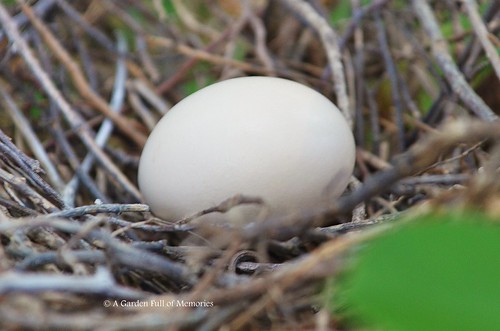
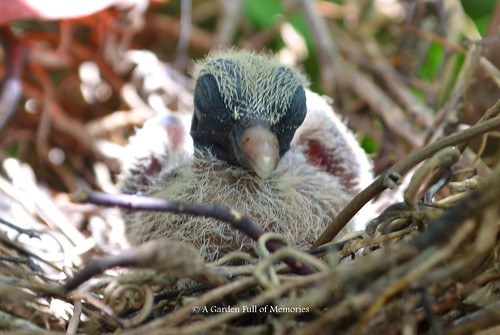
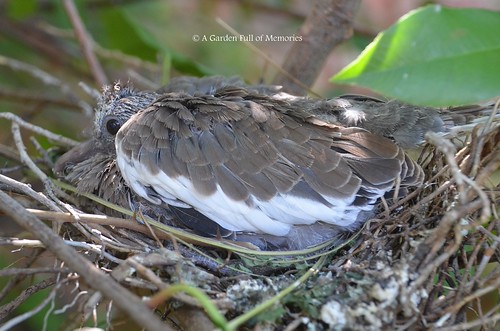
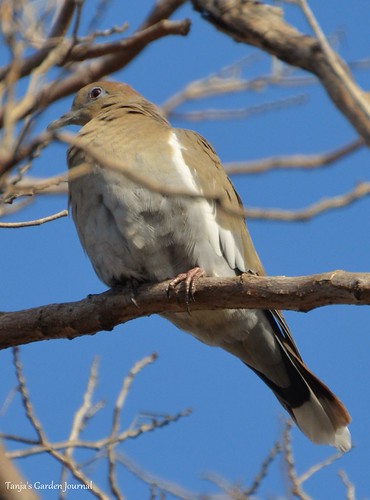
The White-winged Doves (Zenaida asiatica) – also known as Singing or Mesquite Doves – are large, semi-tropical, and pigeon-like doves that occur naturally in the Americas. They are sometimes considered conspecific (one and the same species) with the West Peruvian Dove (Zenaida meloda); however, differences in vocalizations and morphology are credible arguments against this theory. In fact, they may best be placed into the bird genus Columba (typical pigeons) than the dove genus Zenaida (American doves).
White-winged Doves occur naturally in the United States from the Southwest east to Texas and Louisiana, south to Mexico, Central America, and the Caribbean, into parts of western South America. Introduced populations have established themselves in Florida, USA. They have been increasing their range northward. In fact, they have been reported as far north as Alaska to Ontario, Maine, Newfoundland, and most places in between. Most of them are seasonally migratory. They breed in the United States and northern Mexico and travel south to Mexico, Central and South America, and some Caribbean islands for the winter. However, those populations occurring in areas where food is available year-round – in the southern parts of their range – tend to be year-round residents. They inhabit scrub, woodlands, desert, citrus orchards, agricultural fields, and residential areas throughout their range. Many farmers in Mexico refer to them as “la plaga” (the plague) as large flocks – sometimes thousands of them – may descend upon a single field of grain, and decimate it (particularly after the breeding season).





 Under The Harvest Moon